

When Do Rattlesnakes Get Their Rattles
If y'all ever watched a movie set in the desert you are familiar with the audio of a rattlesnake shaking its rattle. This audio is used to signify danger lurking and fifty-fifty people who have non met a rattlesnake in person are sure to recognize it. But can all rattlesnakes rattle? Do baby rattlesnakes have rattles?
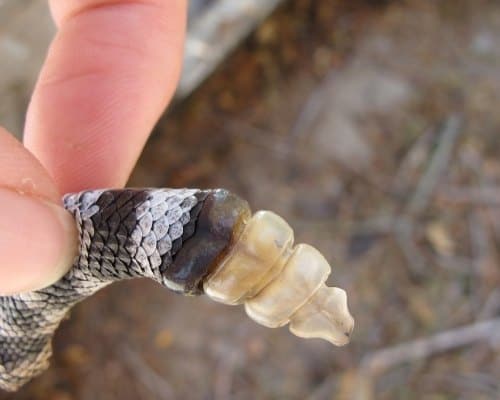
No, they practice non accept rattles yet. The rattle of a rattlesnake grows each time the snake sheds its pare, and since newborn babies have non shed their skin withal, the rattle has non grown. Instead, they take a small knob called a "push" at the end of their tail.
Therefore, baby rattlesnakes cannot give a warning before they strike. Together with the fact that they are mall and much harder to see, it is more difficult to avert getting bitten by them. Luckily, they do not take every bit much venom as fully-grown developed snakes.
RELATED: Is Commonwealth of australia Full Of Snakes, Scorpions, And Spiders?
Even though immature rattlesnakes look different to adults, at that place are enough shared characteristics that make information technology possible to recognize them. Baby rattlesnakes accept the aforementioned, often diamond-shaped, markings on their body as adults practice, You tin can as well recognize venomous snakes by their insufficiently thick middle role of the trunk – non-venomous snakes are by and large thinner and of equal thickness throughout.
Both baby and adult snakes have a roughly triangle-shaped head that connects to a neck that is slimmer than the rest of their trunk.
Rattlesnakes belong to the family of pit vipers. As the proper noun makes clear, pit vipers are distinguished past having two pits below their nostrils which help them sense oestrus and locate warm-blooded prey. Babies, too as adults, have these pits.
Both young and sometime snakes also display the same warning behavior before they strike: they coil, hiss, and rattle all at the same time. Infant snakes will make the aforementioned movements, the just difference is that y'all volition not hear a rattling sound.
RELATED: Are Corn Snakes Nocturnal?
Are Baby Rattlesnakes More Dangerous Than Adults?
For some reason, the myth that the bite of a baby rattlesnake is more than dangerous than the seize with teeth of an developed keeps being spread, even though it has been disproven multiple times. The groundwork of this myth is the idea that, equally opposed to adult snakes, baby snails cannot yet control the amount of venom they inject with a bite.
In fact, the amount of venom is merely one gene that plays into the severity of a snakebite. There are always more things to consider, though; factors related to the snake every bit well as the victim of the bite, like the medical history, the placement of the bite, also as the concrete size.

When it comes to snake-related factors, the two most important ones are the venom composition and the quantity of venom. Snake venom is developed to exercise two things: immobilize or kill prey and aid with digestion. Thus, the composition of the venom is dissimilar with regards to what the snake in question mostly eats.
Since baby rattlesnakes by and large eat small prey like lizards and frogs, their venom is composed of fast-acting neurotoxins, and so that the frogs, for example, do not get to hop away before it begins to have an event. Adult rattlesnakes consume larger mammals, mostly rodents and squirrels.
RELATED: How Do Reptiles Evidence Affection? (Can They Love??)
Because those larger animals have longer to exist digested, it makes sense for the venom to have a higher percent of enzymes that aid in digestion. Therefore, when compared drib to drop, the venom of baby rattlesnakes is indeed more potent. Nevertheless, when it comes to venom quantity, the developed ophidian is conspicuously the winner: adult rattlesnakes produce and inject about xx to 50 times the corporeality of venom that baby snakes produce!

While it is therefore non true that the bites of baby rattlesnakes are more dangerous, any bite should be brought quickly to medical attention. It is best, of course, not to be bitten at all – and this is also what the rattlesnakes themselves would want.
They consider a venomous bite a last-resort defense mechanism and volition give you plenty of warnings before they resort to this method. They will hiss at you, shake their rattle, and often give so-chosen "dry bites" without venom.
When you detect a rattlesnake displaying these signs of aggression, it is best to simply leave it alone. It is non probable to follow you, rattlesnakes do not want to eat you – they but get 3 to 5 feet long, later all – and just desire to be undisturbed. When y'all are in an area where you know at that place are rattlesnakes, simply pay attention when climbing, walking, and turning over rocks. Give these animals space and admire them from a altitude.

When Do Rattlesnakes Get Their Rattles,
Source: https://untamedanimals.com/do-baby-rattlesnakes-have-rattles/
Posted by: alcazarsarlizies.blogspot.com
0 Response to "When Do Rattlesnakes Get Their Rattles"
Post a Comment